
Check vs Checkmate in Chess
Check means your king is under attack and must be made safe immediately. Checkmate means your king is under attack and there is no legal escape, so the game ends at once.
Fast answer: Check is a threat. Checkmate is a finished position with no king move, no block, and no capture that saves the king.
Use the quick tester first, then scroll down for the three legal responses, the checkmate vs stalemate contrast, and a full beginner FAQ.
Check or Checkmate Quick Tester
Decide whether each position is check, checkmate, or neither. Each board explains the exact reason after you answer, so you can train the habit of looking for escape squares before guessing.
Board 1
The king is attacked, but the position is not finished.
Board 2
The king is boxed in with no legal reply.
Board 3
Not every dangerous-looking position is a check.
Board 4
This one looks like mate at first glance, but one legal defence remains.
Board 5
This is the standard beginner trap: no moves does not always mean mate.
Check vs Checkmate (Visual Difference)
If you're unsure why some positions are check but not checkmate, this visual comparison makes it instantly clear.
Check
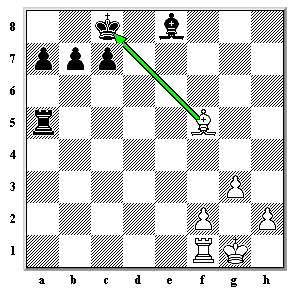
The king is under attack but can still escape.
- ✔ The king can move
- ✔ A piece can block
- ✔ The attacker can be captured
Checkmate
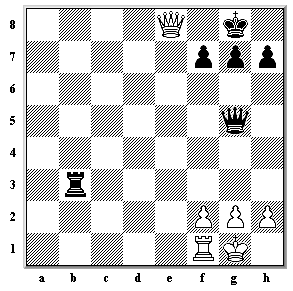
The king is under attack and has no legal move.
- ✖ No safe square
- ✖ Cannot block the attack
- ✖ Cannot capture the attacker
Simple rule: If at least one of the three defenses works, it is check. If none of them works, it is checkmate.
Recognition shortcut: When you see check, do not ask “Am I losing?” first. Ask “Can I move the king, can I capture the attacker, or can I block the line?”
What Check Means
A king is in check when an enemy piece attacks the square the king stands on. You are not allowed to ignore that attack, and you are not allowed to answer with a move that still leaves your king attacked.
Important rule: The king is never actually captured in legal chess. The game stops at checkmate because the trapped king has no legal defence left.
The 3 Ways to Get Out of Check
Every legal response to check falls into one of these three options. If none of them works, the position is checkmate.
1. Move the King
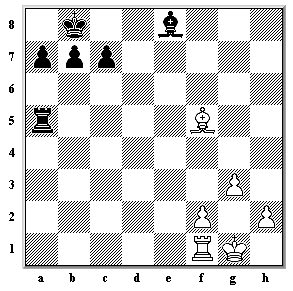
The king escapes to a square that is not under attack.
2. Block the Check
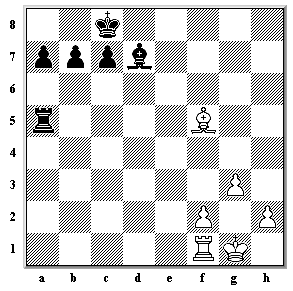
A piece is placed between the attacker and the king.
3. Capture the Attacker
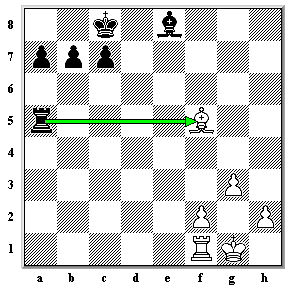
The attacking piece is captured, removing the threat.
Key idea: If at least one of these three options works, it is check. If none of them works, it is checkmate.
Checkmate vs Stalemate
Checkmate and stalemate both leave the defender with no legal move, but the result is different because only checkmate includes a king that is currently under attack.
Checkmate
The black king is attacked and every escape resource has failed.
Stalemate
The black king has no legal move, but the king is not attacked, so the game is drawn.
- Check: the king is attacked and must be saved.
- Checkmate: the king is attacked and cannot be saved.
- Stalemate: the side to move has no legal move, but the king is not attacked.
Check and Checkmate FAQ
These short answers are written for real beginner confusion: what counts as check, what is illegal, what ends the game, and what only looks like mate.
Core rules
What is check in chess?
Check in chess means your king is under direct attack and you must answer that threat immediately. The core rule is that a king may never stay on an attacked square after a legal move. Use the Check or Checkmate Quick Tester to spot exactly why one attacked king can escape and another cannot.
What is checkmate in chess?
Checkmate in chess means the king is in check and there is no legal way to escape. Checkmate ends the game at once because all three defensive resources have failed. Try the Check or Checkmate Quick Tester to see a boxed king with no safe square, no block, and no capture.
What is the difference between check and checkmate?
The difference is simple: check is a threat, while checkmate is a finished position with no legal escape. Every checkmate begins with check, but many checks can still be met by moving, blocking, or capturing. Compare the Check or Checkmate Quick Tester boards to reveal the exact extra detail that turns check into mate.
Do you have to get out of check immediately?
Yes, you must get out of check immediately on your very next move. Chess rules do not allow you to ignore a direct attack on your king and play something elsewhere. Review the Three Legal Responses boards to trace the only kinds of moves that count as a valid reply.
What are the three ways to get out of check?
The three ways are to move the king, block the line of attack, or capture the attacking piece. Those are the only legal responses because each one removes the attack on the king after the move is completed. Step through the Three Legal Responses boards to watch each defensive method appear on the board.
Can you move any piece when you are in check?
No, you can only play a move that removes the check from your king. A move that attacks something else but leaves your king exposed is illegal no matter how strong it looks. Use the Check or Checkmate Quick Tester to catch positions where flashy moves fail because king safety still comes first.
Can you capture the piece giving check?
Yes, you can capture the checking piece if the capture leaves your king safe afterward. The important detail is the final position, not the intention of the move. Study the Capture the Attacker board to see a legal capture that removes the threat in one move.
Can you block every check in chess?
No, you cannot block every check in chess. Blocking works only against sliding attacks from a bishop, rook, or queen when there is a square between the attacker and the king. Inspect the Block the Check board to see exactly where an interposing piece can stop a line attack.
Can you block a knight check?
No, you cannot block a knight check. Knights jump directly to their target square, so there is no line between attacker and king to plug with a piece. Use the Check or Checkmate Quick Tester to compare line attacks with jumping attacks and spot why a knight check behaves differently.
Can the king capture a checking piece?
Yes, the king can capture a checking piece if the destination square is not attacked by another enemy piece. Kings obey the same safety rule after capturing as after any other king move. Review the Quick Tester explanations to see why one capture works in one position and fails in another.
Illegal moves and king safety
Can you castle out of check?
No, you cannot castle out of check. Castling is illegal if the king starts the move in check, passes through an attacked square, or lands on an attacked square. Use the Three Legal Responses boards here first, then move on to castling lessons knowing that king safety is the deciding rule.
Can you move into check in chess?
No, you cannot move into check in chess. A move is legal only if your king is safe on the final square after the move has been played. Test yourself with the Quick Tester to separate squares that look open from squares that are still controlled by the opponent.
Can you leave your king in check?
No, you cannot leave your king in check. Any move that finishes with your king still attacked is illegal and must be taken back in proper play. Use the Three Legal Responses boards to see the standard legal escapes that replace panic with a simple rule check.
Can a pinned piece still block a check?
Yes, a pinned piece can sometimes block a check if the blocking move itself is legal and leaves the king safe. The word pinned matters less than the final legality of the board after the move. Look at the Block the Check board to focus on the attack line rather than the label on the defender.
Does checkmate end the game immediately?
Yes, checkmate ends the game immediately. There is no extra move, no further defence, and no need to capture the king because the trapped king already decides the result. Compare the mate position in the Quick Tester with the safe and escape positions to see the finality of mate.
Do you have to be in check before checkmate?
Yes, the king must be in check for the position to be checkmate. A side with no legal moves but not in check is stalemate, which is a draw instead of a loss. Compare the Checkmate board and the Stalemate board to see the single attacked square issue that changes the result.
What happens if you cannot get out of check?
If you cannot get out of check, you are checkmated and the game is over. That means none of the three legal defences works in the position in front of you. Use the Quick Tester to recognise that moment before you waste time hunting for a move that does not exist.
Is checkmate the same as winning the game?
Yes, delivering checkmate wins the game immediately. In standard chess, the king is never physically captured because mate ends the game one move earlier. Study the Quick Tester mate examples to see how the win comes from trapping the king, not from taking it.
Can you checkmate with only a king?
No, you cannot checkmate with only a king. A lone king has too little force to attack and trap the enemy king within the legal movement rules. Use the Checkmate and Stalemate contrast section to understand why kings need help to remove all escape squares.
Can a king put another king in check?
A king attacks the squares around it, so kings can never stand next to each other because that would place a king in check. The practical rule is that kings must keep one square of separation. Watch the board highlights in the Quick Tester to understand how king control makes adjacent kings illegal.
Can two kings check each other?
No, two kings cannot legally check each other from adjacent squares because that position is illegal to begin with. King adjacency breaks the rule that your own king may not move into attack. Use the Quick Tester explanations to see how king-controlled squares quietly shape legal movement.
Checkmate, stalemate, and result confusion
Is stalemate the same as checkmate?
No, stalemate is not the same as checkmate. Stalemate means the side to move has no legal moves but is not in check, so the game is drawn. Compare the Checkmate board and the Stalemate board to spot the one missing attack that changes a loss into a draw.
What is the difference between checkmate and stalemate?
The difference is that checkmate includes an attacked king, while stalemate does not. Both positions have no legal moves for the defender, but only checkmate ends in a win for the attacker. Use the Checkmate and Stalemate contrast boards to reveal that decisive attacked-square difference.
Do you have to say check in chess?
No, you do not have to say check in formal chess rules. Players are still responsible for noticing attacks on their own king, even though many casual games include the spoken warning. Train with the Quick Tester to recognize checks visually instead of relying on someone to announce them.
When do you say checkmate in chess?
You say checkmate when the king is in check and there is no legal escape. The key is not the word itself but the board fact that every defensive resource has failed. Use the Quick Tester mate positions to confirm that no king move, block, or capture survives.
How is check shown in chess notation?
Check is usually shown with a plus sign after the move in algebraic notation. That symbol records that the move attacked the enemy king without ending the game immediately. Read the Quick Tester explanations and then notice how ordinary checks differ from mating moves in practical play.
How is checkmate shown in chess notation?
Checkmate is usually shown with a hash symbol after the move in algebraic notation. The symbol marks a final move because the attacked king has no legal reply. Use the mate examples in the Quick Tester to connect the notation mark with the trapped king on the board.
Beginner confusion and pattern recognition
Can a discovered attack be check?
Yes, a discovered attack can be check if moving one piece reveals an attack on the king from another piece behind it. The important idea is line opening, where the hidden rook, bishop, or queen suddenly gains access to the king. Use the Three Legal Responses boards here first so you can recognise the attack line that must be stopped.
What is double check in chess?
Double check is a position where two pieces attack the king at the same time from one move. Because two threats are active, the only legal response is usually to move the king. Practice with the Quick Tester first so single-check logic becomes automatic before you meet more forcing cases.
Why is blocking impossible in some check positions?
Blocking is impossible when the attack does not travel along a line that can be interrupted. Knight checks, king attacks, and many close-range checks cannot be plugged by placing a piece in between. Compare the Block the Check board with the Quick Tester attack patterns to see which threats leave no blocking square.
Why do beginners mix up check and checkmate?
Beginners mix them up because both positions start with the king under attack, but only one removes every legal escape. The practical difference often comes down to one hidden safe square or one possible capture that is easy to miss. Use the Check or Checkmate Quick Tester to reveal those tiny escape details one board at a time.
What should I look for first when I am in check?
First, look for a safe king move because it is the fastest way to test whether the position is mate or not. After that, check whether you can capture the attacker or block the line if the attack comes from a rook, bishop, or queen. Follow the Three Legal Responses boards in that order to build a calm over-the-board routine.
Main takeaway: Check is a warning, not the end of the game. The fastest way to judge the position is to scan for a king move, a capture, or a block before you panic.